Research Stories

“What now?” How the unexpected “No” referendum victory changed Colombians’ views on a negotiated end to the conflict

In 2016, Colombians narrowly rejected the deal to end the war with the FARC. A national survey happened to be in the field when it happened. Comparing people interviewed before and after the vote shows what the shock did to views on war and peace.

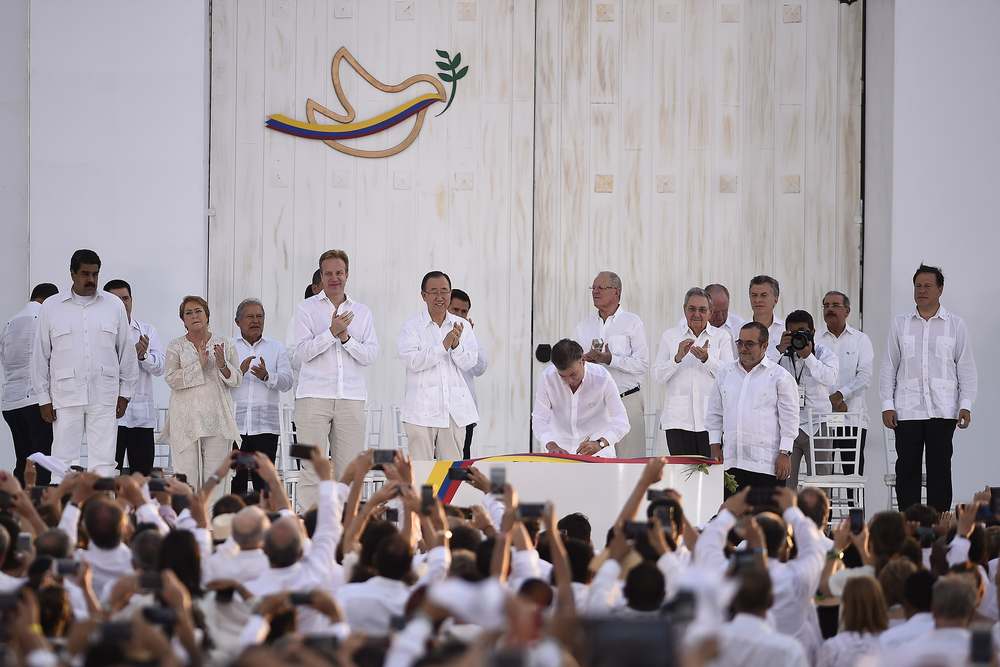
On a stage in Cartagena, President Juan Manuel Santos signs the peace agreement while dignitaries dressed in white applaud and a crowd holds up phones.
Signing ceremony of the peace agreement, Cartagena, September 26, 2016. Photo: Gobierno de Chile, CC BY 2.0

On September 21, 2016, President Juan Manuel Santos stood before the United Nations General Assembly and told the world: “After more than half a century of internal armed conflict, I come back to the United Nations today, on the International Day of Peace, to announce, with all the strength of my voice and of my heart: The war in Colombia has ended.”

Almost two weeks later, Colombians voted the deal down.

This story is a special one for me. Like millions of Colombians, my life has taken an unexpected course because of that conflict. To a large extent, I ended up in academia because of it.

Graphic: A quotation card. Juan Manuel Santos at the United Nations, September 21, 2016: "The war in Colombia has ended."

The deal Santos announced was the end point of four years of negotiations with the FARC, the longest-running armed insurgency in the Western Hemisphere. The rebels had kept a ceasefire for almost two years.

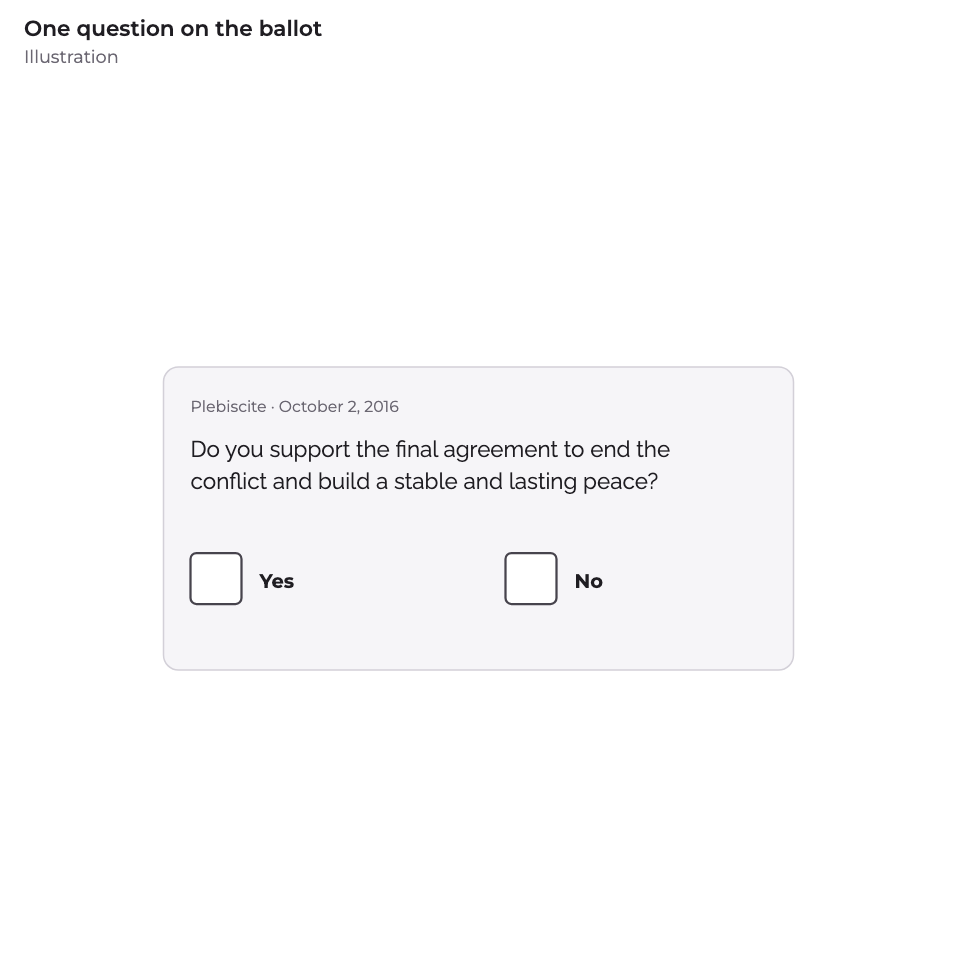
In what many commentators suggest was an attempt to give the agreement democratic legitimacy, the government put it to a popular vote, with a single question: “Do you support the final agreement to end the conflict and build a stable and lasting peace?”

Graphic: A ballot with one question: "Do you support the final agreement to end the conflict and build a stable and lasting peace?" Two boxes: Yes and No.

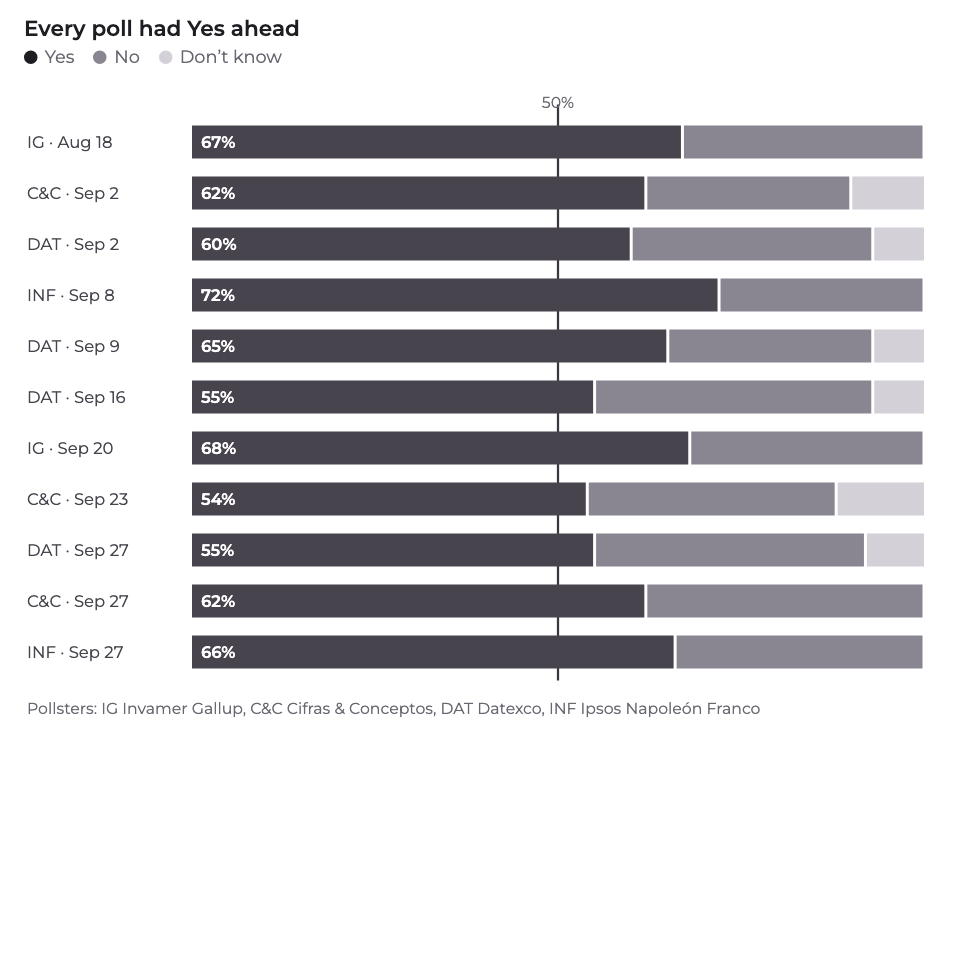
Almost everyone expected a formality. Polls showed Yes comfortably ahead. Santos himself said: “I don’t have a plan B in case the plebiscite is not approved, because I think there will be no need for a plan B.”

Graphic: Eleven opinion polls from August and September 2016. In every one, Yes is ahead of No, often by a wide margin.

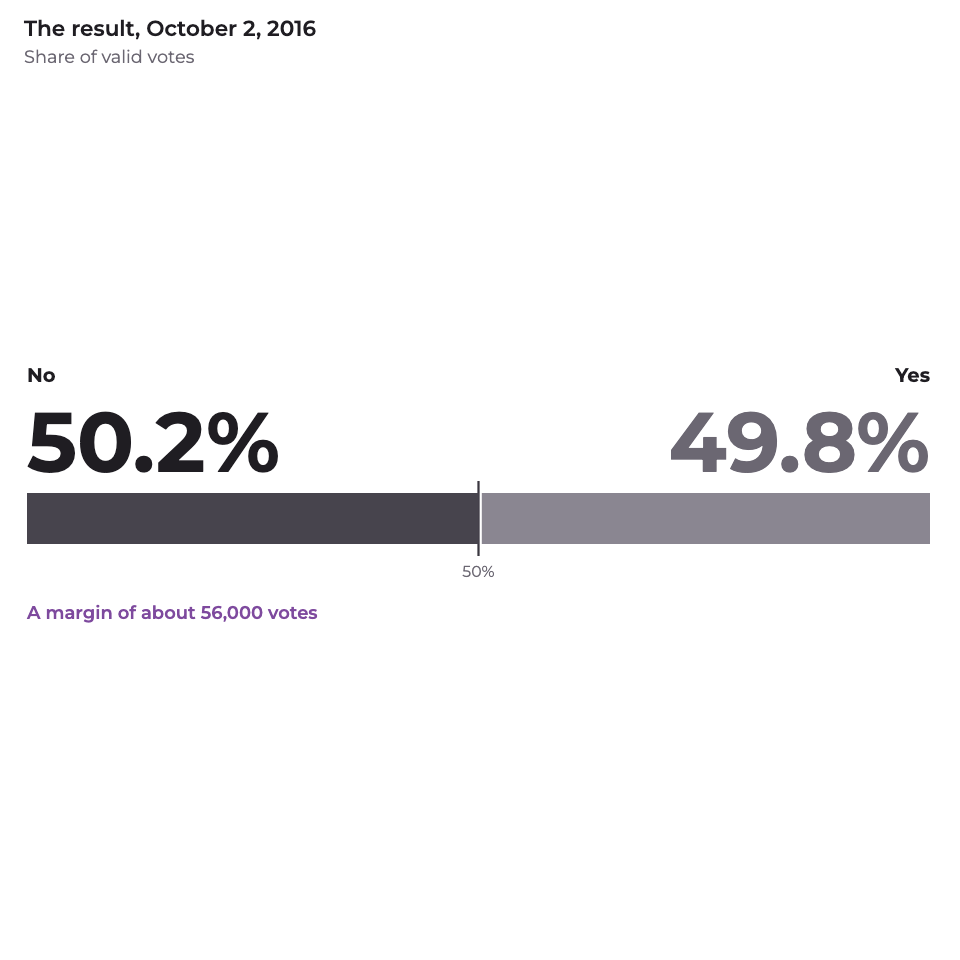
On October 2, against the predictions, the No won: 50.2% to 49.8%, a margin of about 56,000 votes.

The result left Colombia, and everyone watching, in shock. After years of talks and a ceasefire, a question hung over the country: what now?

Graphic: The result: No 50.2%, Yes 49.8%. The No side won by about 56,000 votes.

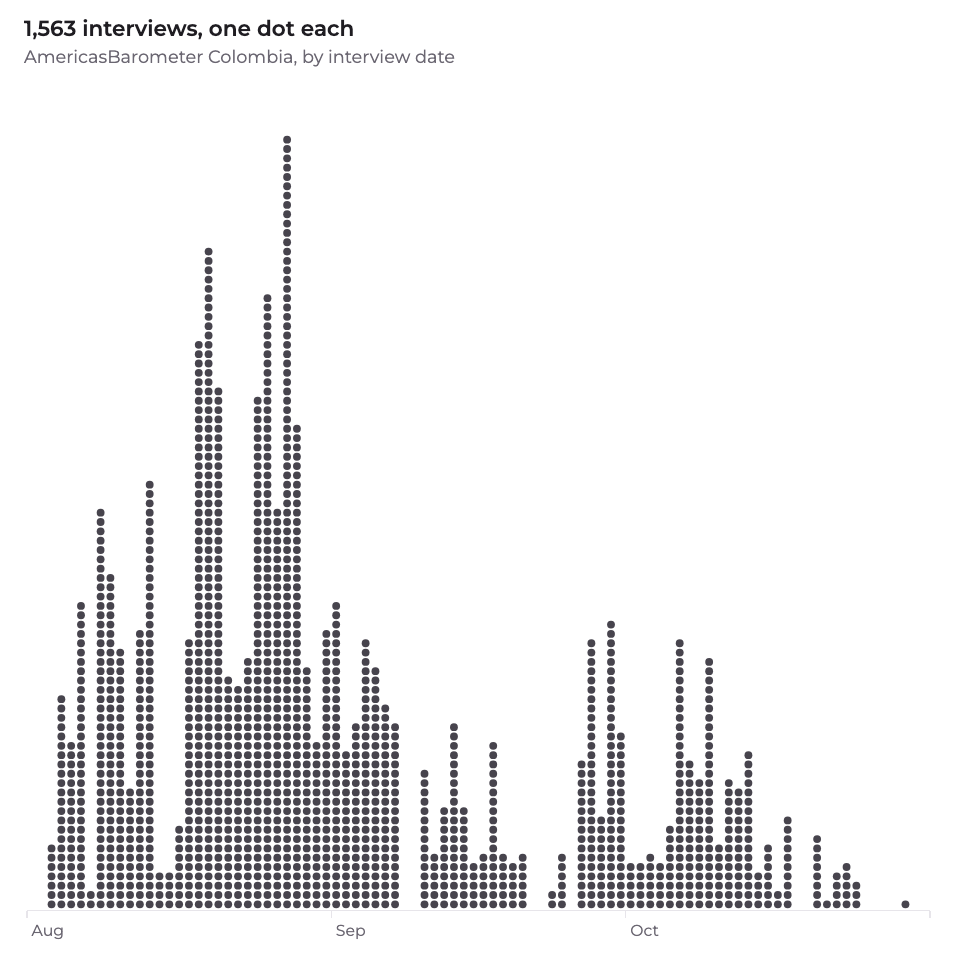
As it happened, a national survey was in the field. Between August 3 and October 29, the AmericasBarometer interviewed 1,563 Colombians, face to face, about politics and the conflict.

Each dot here is one of those interviews, placed on the day it took place.

Graphic: 1,563 small dots, one per survey respondent, stacked in columns along a calendar from August 3 to October 29, 2016. Each column is one day of interviews.

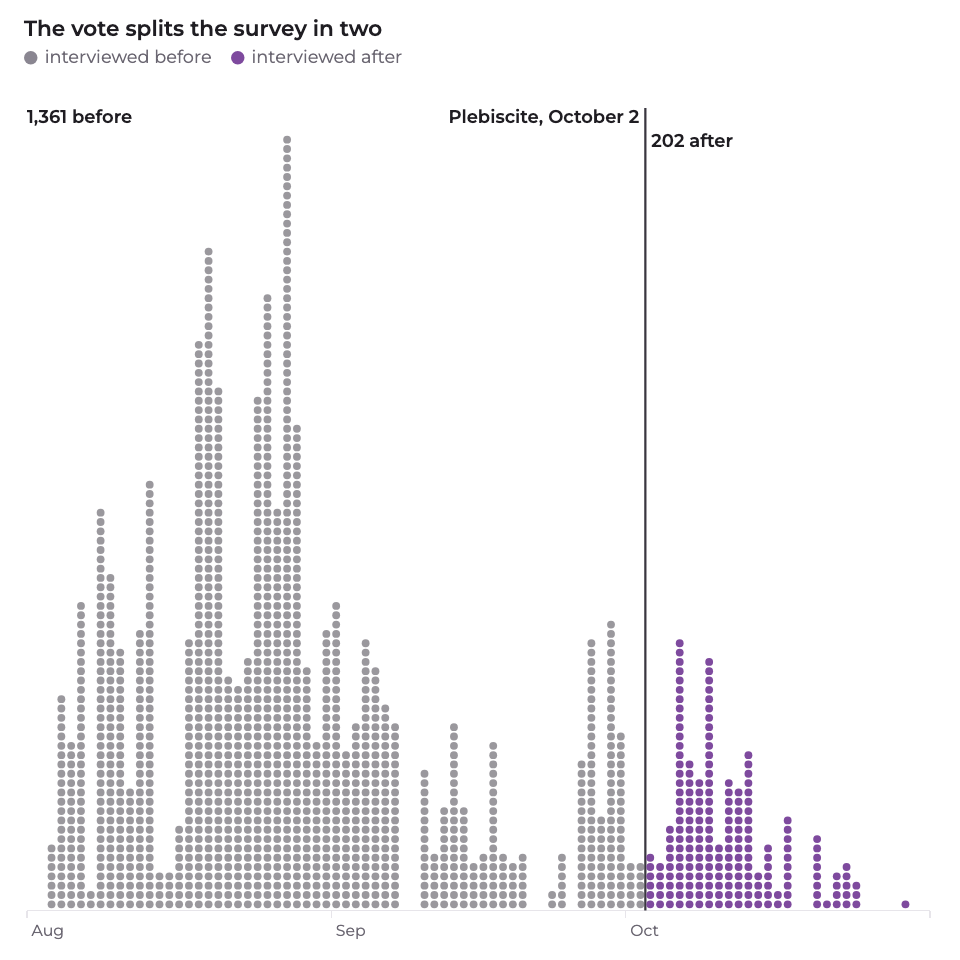
The plebiscite cut the survey in two. 1,361 people were interviewed in the about nine weeks before the vote. 202 were interviewed in the about four weeks after it, when the future of the peace process was suddenly up in the air.

The design rests on one idea: whether someone was interviewed before or after the vote depended on the fieldwork calendar, not on their views about peace. If that holds, the two groups are comparable, a bit like a natural experiment. Researchers call this an “unexpected event during survey” design.

The groups look alike on most characteristics. One difference: the later group includes more people from conflict-affected areas. I check that this, and other alternative explanations, don’t drive the results.

Graphic: A vertical line marks October 2. The 1,361 dots to its left, interviewed before the plebiscite, are gray. The 202 dots to its right, interviewed after, are highlighted.

So, did the shock change what people thought? First, the most direct question: support for the signed agreement between the Santos government and the FARC.

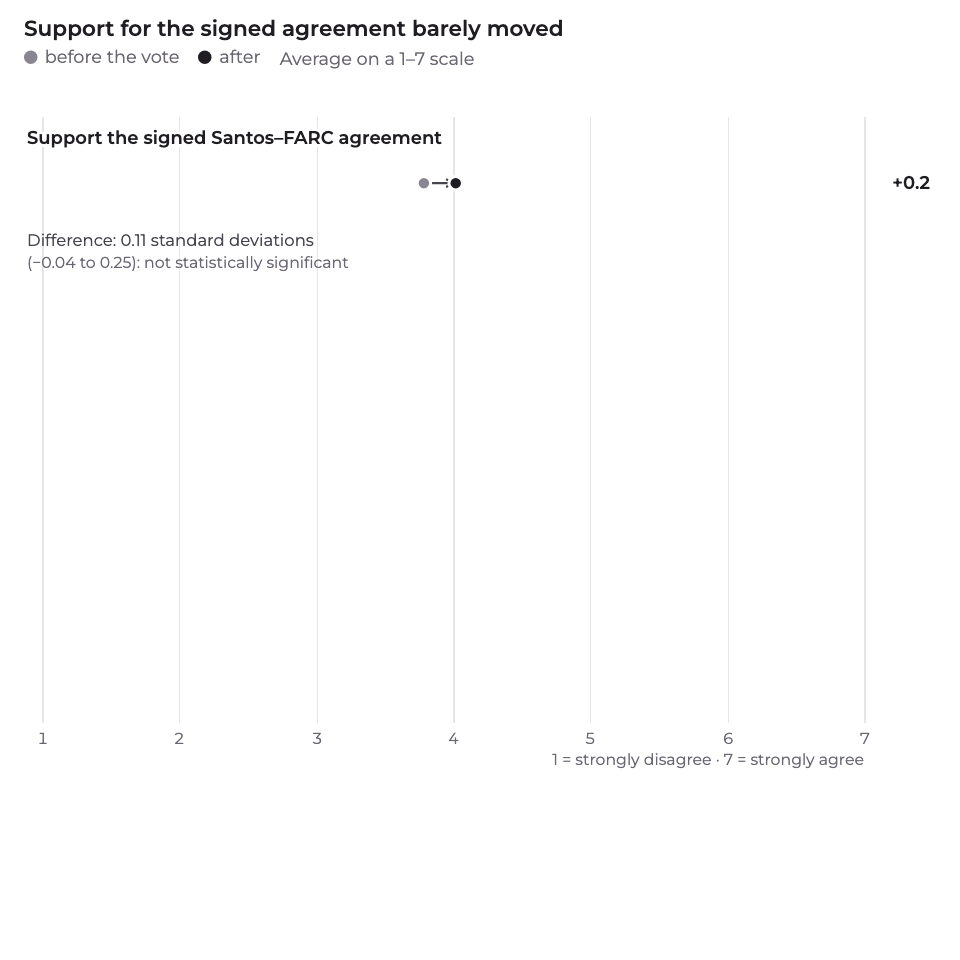
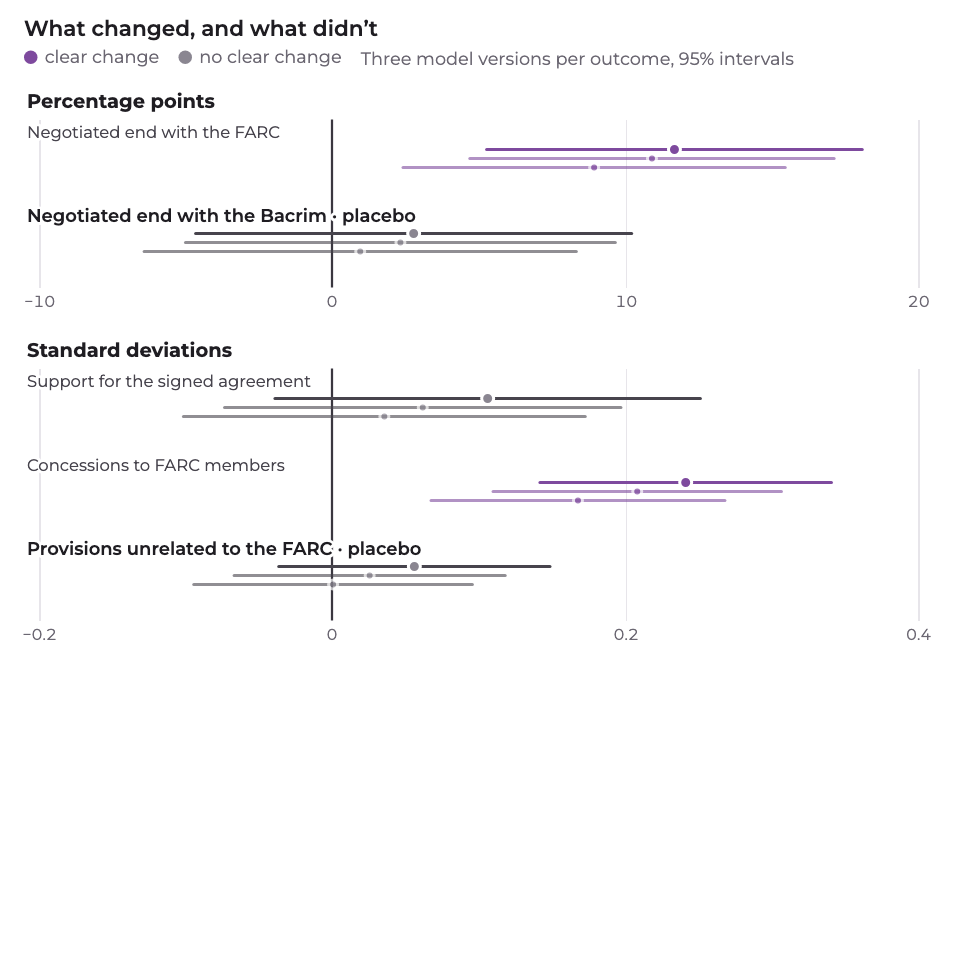
Here, almost nothing moved. On a scale from 1 to 7, average support went from 3.8 to 4.0. That is a difference of 0.11 standard deviations, with a range from −0.04 to 0.25 that includes zero.

The deal that came to be known as “Santos’ peace” was no more popular after its defeat.

Graphic: Two bars on a scale from 1 to 7 for support for the signed Santos–FARC agreement: 3.8 before the plebiscite, 4.0 after. The difference is small and not statistically significant.

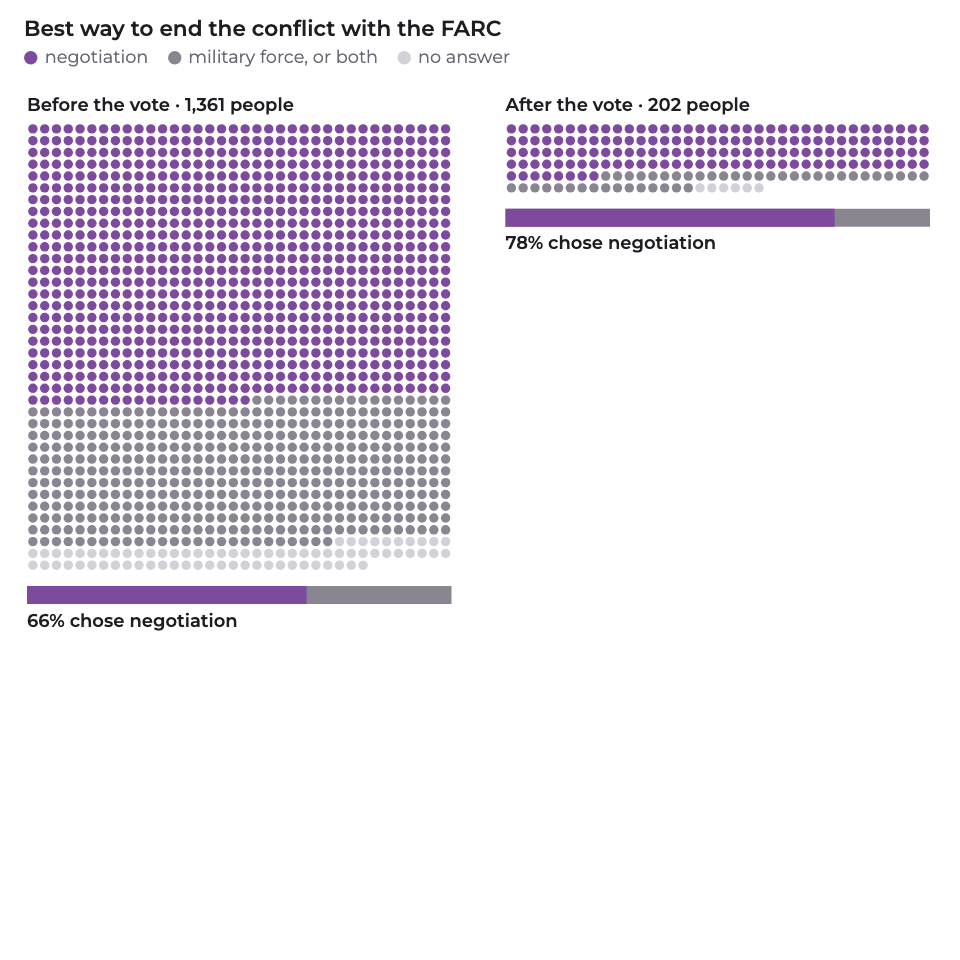
But ask a broader question, and the picture changes. The survey asked what the best way to end the conflict with the FARC was: negotiation, military force, or both.

Before the plebiscite, 66% of those who answered chose negotiation. After it, 78% did.

Accounting for differences between the two groups, that is around 10 percentage points more support for a negotiated end to the conflict.

Graphic: The dots regroup into two blocks: people interviewed before the plebiscite and people interviewed after. Dots are colored by their answer on the best way to end the conflict with the FARC. Before, 66% chose negotiation; after, 78%.

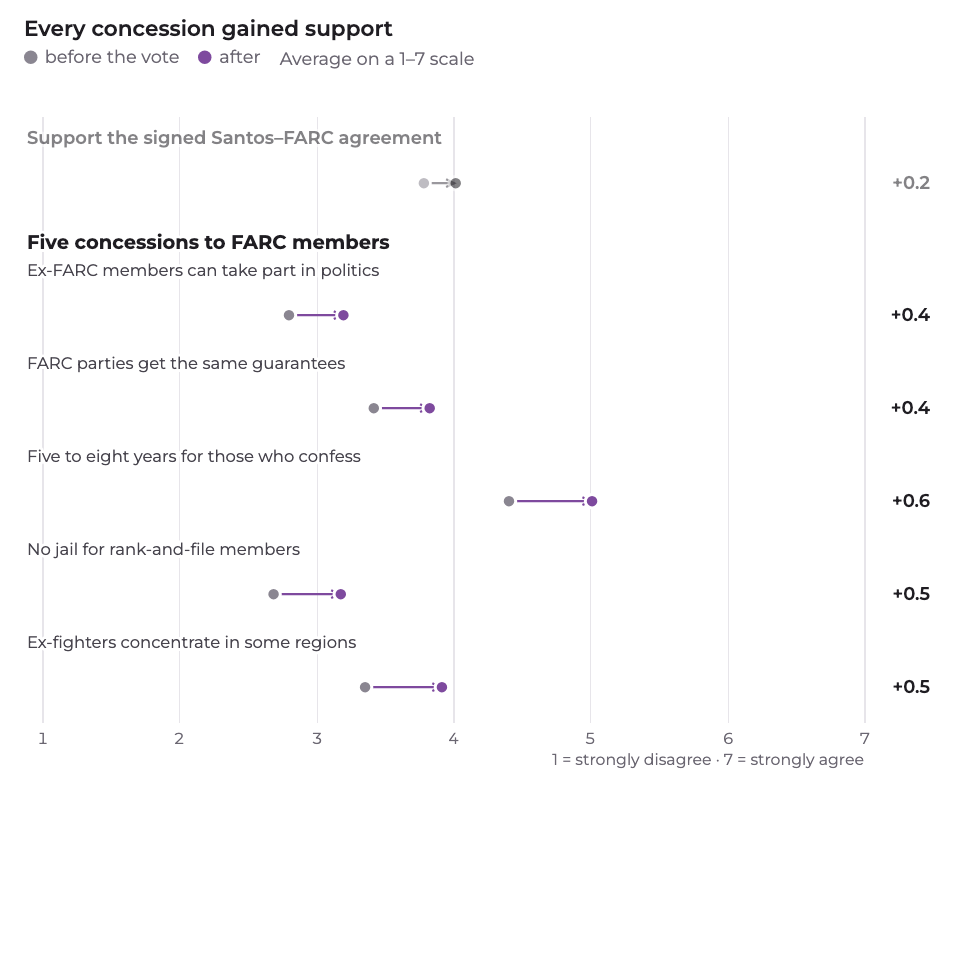
People also became more willing to accept the concessions at the heart of the agreement: letting demobilized FARC members take part in politics, giving their parties the same guarantees as others, five to eight years of deprivation of liberty for those who confessed to atrocious crimes, no jail for rank-and-file members, and concentrating former fighters in some regions.

Every one of these five items rose. Taken together, willingness to make concessions went up by around 0.2 standard deviations.

Graphic: Five survey items on concessions to FARC members, each on a 1–7 scale, with an arrow from the average before the plebiscite to the average after. All five arrows point up, by 0.4 to 0.6 points.

Could something else explain this, like a general mood that shifted over those weeks? If so, other attitudes should have moved too.

They didn’t. Support for negotiating with the Bacrim, the criminal groups that grew out of the right-wing paramilitaries, stayed flat. So did support for parts of the agreement that had nothing to do with FARC combatants, such as land redistribution.

The change was specific to the FARC and the deal’s concessions to them.

Graphic: Two estimates sit on the zero line: support for a negotiated end with the Bacrim, the criminal groups that grew out of right-wing paramilitaries, and support for parts of the agreement unrelated to FARC combatants. Neither changed.

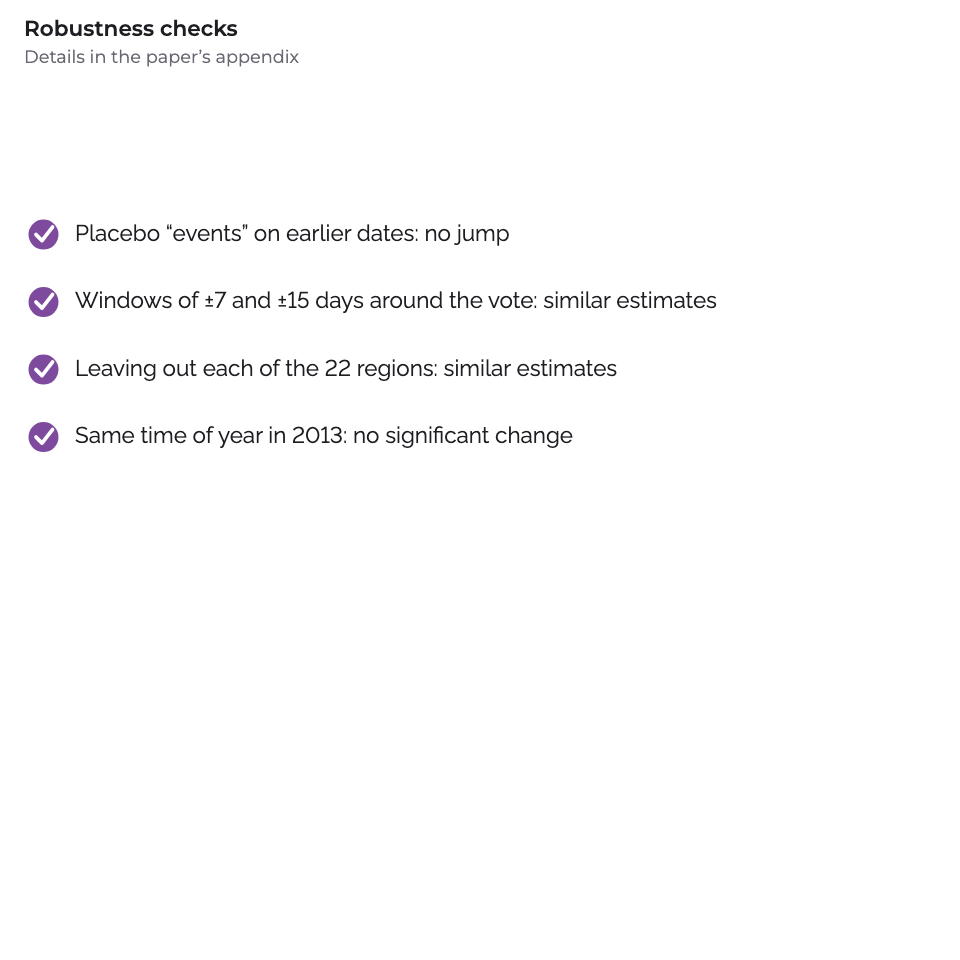
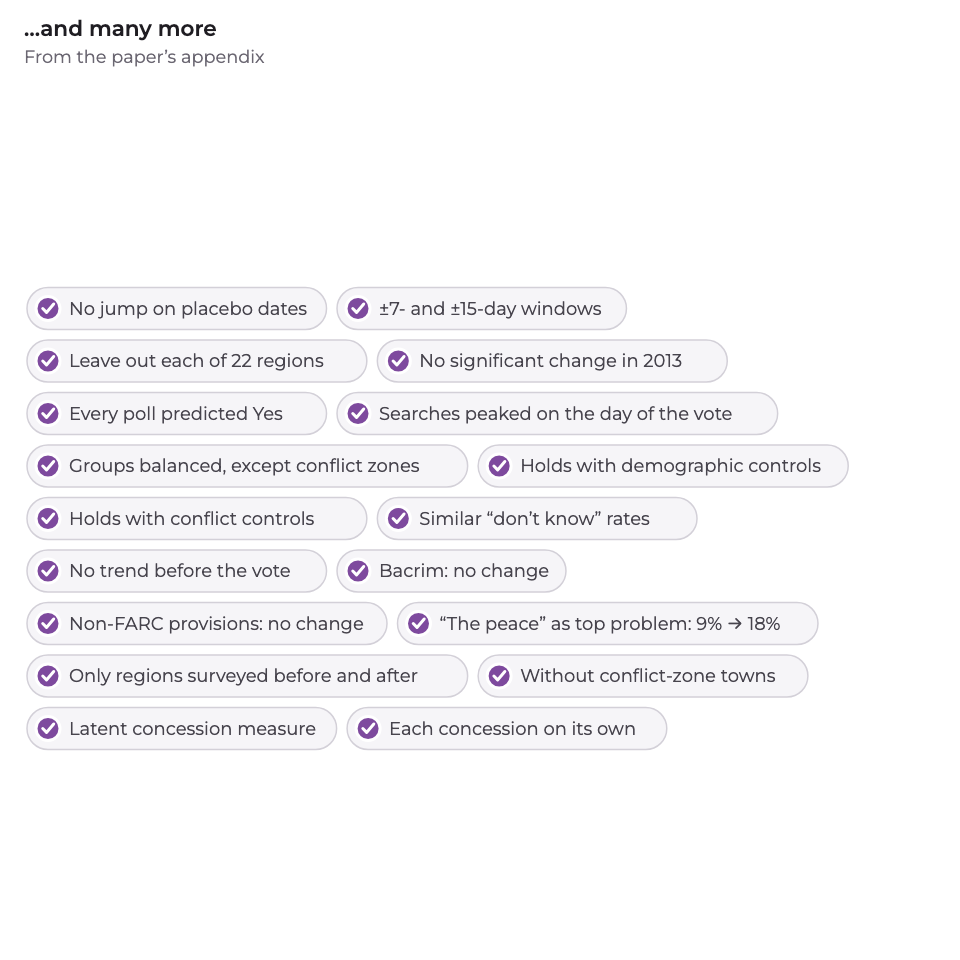
I also put the result through the standard checks for this kind of design. Placebo “events” on earlier dates show no jump. Narrow windows of 7 and 15 days around the vote give similar estimates. So does leaving out each of the 22 regions in turn. And in the 2013 survey, fielded at the same time of year, people interviewed after early October were not significantly more supportive of negotiation.

Graphic: A checklist of robustness tests: placebo dates before the plebiscite, narrower windows of 7 and 15 days around the vote, leaving out each of the 22 regions in turn, and the same calendar in the 2013 survey. None of them undermines the result.

And that’s just the start. The appendix works through the full checklist for this kind of design, and then some.

The polls all predicted Yes, and searches for the plebiscite peaked on the day of the vote, so the result really was a surprise. The two groups are similar on most characteristics, answered “don’t know” about as often, and showed no trend before the vote. After it, twice as many people named the peace process as the country’s most important problem: the vote registered. And the results hold with controls, in subsets of regions, without conflict-zone towns, and with other ways of measuring concessions.

Graphic: The four checks shrink into a wall of small check marks that keep appearing, eighteen in all: from polls that predicted Yes and searches that peaked on the day of the vote, to balance tests, controls, response rates, trends before the vote, placebo outcomes, and alternative ways of measuring concessions.

What changed, then? For almost two years, the war had been winding down. The No vote suddenly put a return to fighting, or some unknown alternative, back on the table.

Faced with that uncertainty, people seem to have weighed the costs of war and peace differently: more of them favored negotiating, and more were willing to make concessions to get there.

But the agreement itself, tied to Santos and to a polarized campaign, did not gain support. Endorsing “Santos’ peace” seems to have meant something different from wanting peace.

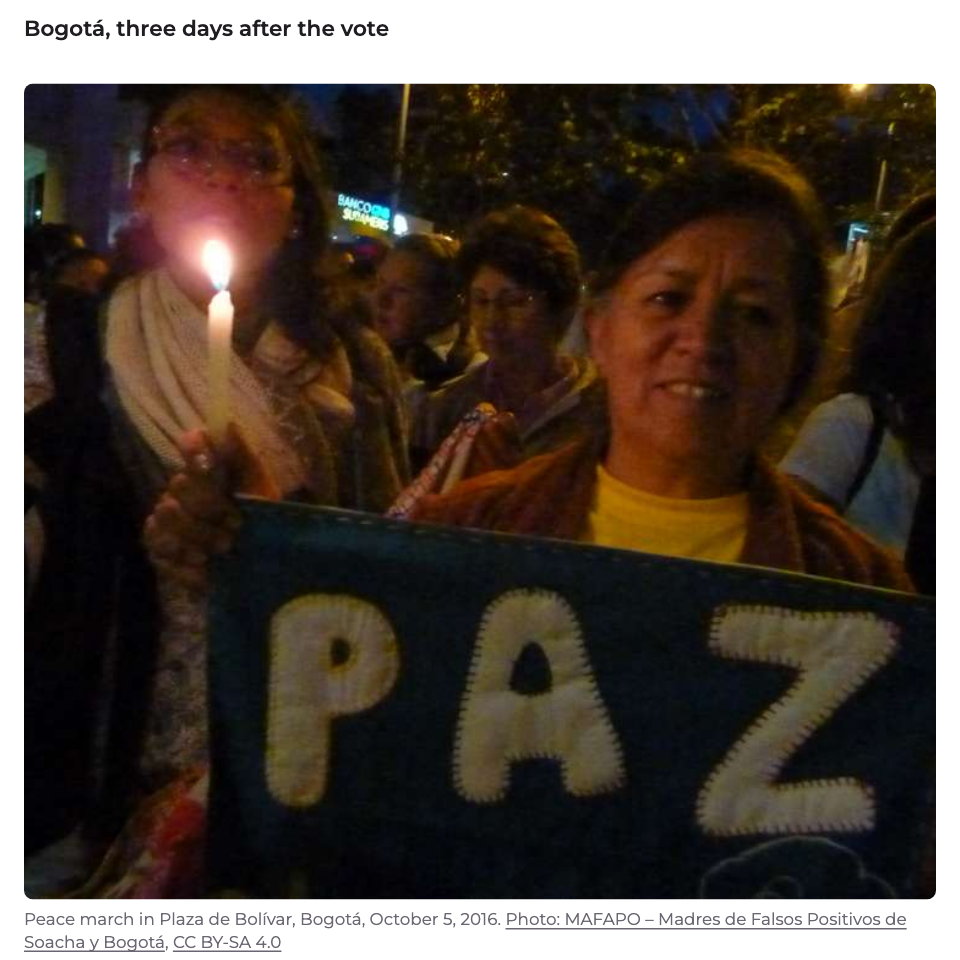
Graphic: Photo: at a night march for peace in Bogotá three days after the plebiscite, a woman holds a candle and a woman beside her holds a handmade banner reading PAZ, peace.

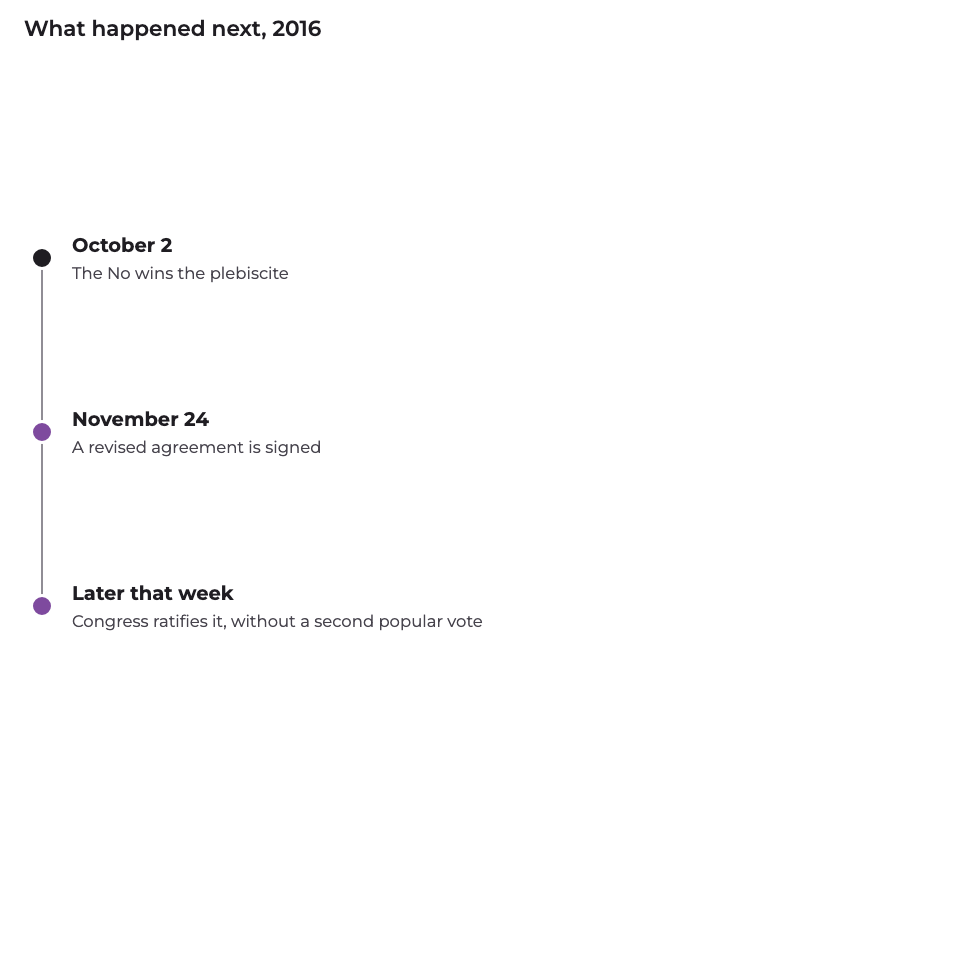
The story did not end with the No. The government went back to the table with the FARC and the No campaign. A revised agreement was signed on November 24, and Congress ratified it later that week, without a second popular vote.

A few caveats. The group interviewed after the vote is small, 202 people. It includes more people from conflict areas than the group before. And Colombia’s war was not an identity-based conflict; things may work differently where it is.

Still, the plebiscite offers a rare look at how people’s views on ending a war respond when the path to peace suddenly becomes uncertain.

Graphic: A short timeline: October 2, the No wins; November 24, a revised agreement is signed; later that week, Congress ratifies it without a second popular vote.

How I made this

This story is based on my article in Research & Politics (2024). The survey is the 2016 AmericasBarometer for Colombia by LAPOP, a national probability sample of voting-age adults interviewed face to face. Respondents interviewed after October 2 are compared with those interviewed before, using regressions with and without controls for demographics and conflict exposure.

Each dot in the charts is one respondent, placed on the day of the interview. The published data behind the dots contain only the interview date and one answer, in shuffled order. Every estimate shown was re-run from the reproduction materials and matches the published figures.

See the survey items behind these charts

Average answers among people interviewed before and after the plebiscite. Agreement items are on a 1–7 scale (7 = strongly agree); the negotiation item is the share choosing negotiation.

ItemTypeBeforeAfter
Support the signed Santos–FARC agreementAgreement3.794.02
Negotiation is the best way to end the conflictNegotiated end0.660.78
Demobilized FARC members can participate in politicsPolitical2.803.20
FARC parties get the same security and media guaranteesPolitical3.423.83
5–8 years of deprivation of liberty for those who confess atrocious crimesJudicial4.415.01
No jail for rank-and-file membersJudicial2.693.18
FARC members concentrate in some regionsTerritorial3.363.92

The paper

Sebastian Ramirez-Ruiz (2024). “The unexpected results of the Peace Referendum changed conflict termination preferences in Colombia.” Research & Politics 11(1). DOI: 10.1177/20531680241233793

← More Research Stories